
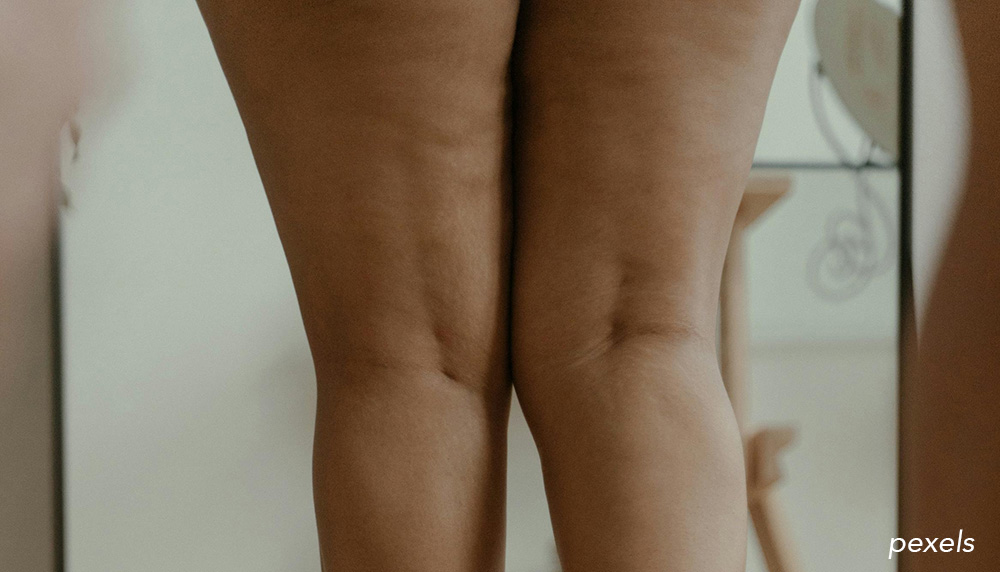
Understanding to better transform your skin
Cellulite… that little nine-letter word that sparks just as many sighs as passionate conversations in front of the mirror. And yet! Behind this skin phenomenon—about as common as April rain—lie several types of cellulite, each with its own personality, quirks, and favorite ways of settling into our bodies. Identifying them is already a victory: you can’t fight what you don’t understand.
Let’s dive together into the fascinating—and sometimes slightly mischievous—world of cellulite to learn how to recognize it, decode it, and manage it better.
What differentiates the types of cellulite?
Before reviewing the three main forms, let’s recall an essential truth: cellulite is neither a disease nor a sign of poor lifestyle habits. It is multifactorial—genetic, hormonal, circulatory, structural—and its form depends on how the subcutaneous tissues react.
We mainly distinguish:
- Adipose cellulite
- Aqueous cellulite
- Fibrous cellulite
Some women even present a mix of these forms, just to make the mission a bit more interesting.
1. Adipose cellulite: the gentle rebel
Adipose cellulite is often the most common. It’s the “easygoing” one, settling comfortably in areas where fat cells like to relax.
How to recognize it
- “Soft” appearance, little to no pain
- Medium-depth dimpling: the orange-peel look appears mainly when pinching the skin or contracting muscles
- Common locations: hips, thighs, buttocks, abdomen
This form appears when adipocytes (fat cells) store too much energy as lipids. When storage exceeds capacity, the adipocytes swell, creating pressure on surrounding tissues… and hello dimples.
Why does it appear?
- Diet too rich in fast sugars or processed fats
- Lack of physical activity
- Genetic predisposition to fat storage
- Hormonal imbalances promoting lipogenesis
Can it be reduced?
Yes—and it’s actually the most “cooperative” type! By combining:
- Muscle strengthening to firm the tissue
- Better sugar management to limit insulin fluctuations
- Regular massages to improve local circulation
2. Aqueous cellulite: the sensitive one that retains everything
Aqueous cellulite, or “infiltrated” cellulite, is linked to poor lymphatic and venous circulation. It’s the body’s “fluid hibernation” mode.
How to recognize it
- Swollen skin, sometimes cold to the touch
- Sensation of heavy or tired legs
- Orange-peel appearance visible even without pinching
- Presence of mild edema
It often appears in people who spend long periods sitting or standing, those with naturally sluggish circulation, or during hormonally sensitive periods (menstrual cycle, pregnancy, pre-menopause).
Why does it appear?
- Slowed lymphatic circulation → fluid accumulation in tissues
- Water retention linked to sodium/potassium imbalance
- Familial venous insufficiency
- Sedentary lifestyle or prolonged standing
How to improve it
- Move regularly: walking, gentle trampoline, cycling
- Drain fluids through lymphatic massage or self-massage
- Reduce excess salt and increase potassium-rich vegetables
- Wear compression socks during long static days
This type of cellulite responds very well to draining treatments—which can make the transformation quite spectacular!
3. Fibrous cellulite: the determined, long-term version
Fibrous cellulite is the oldest and most “stubborn” type. It settles deep, becomes rigid, and sometimes seems indifferent to superficial efforts.
How to recognize it
- Hard, compact texture
- Dimples visible at all times
- Skin sometimes sensitive to pressure
- Occasionally a slightly purplish color
Here, collagen fibers stiffen and trap the adipocytes. The result: deeper surface indentations and firmly anchored dimples.
Why does it appear?
- Lack of skin stimulation (weakening of fibers)
- Natural aging of collagen
- Gradual fat accumulation under less firm skin
- Chronic local inflammation
How to improve it
It requires a combined approach—but yes, its appearance can be softened!
- Regular massages to loosen the fibers
- Targeted physical activity to firm and boost circulation
- Antioxidant-rich diet to reduce inflammation
- Specialized technologies (radiofrequency, ultrasound, laser) for a technical boost
Mixed cellulite: when several forms coexist
Most women have a combination of two or three types. For example:
- Aqueous + adipose
- Adipose + fibrous
- Aqueous in the lower legs + fibrous on the buttocks
Each body area can have its own “cellulite signature,” which is why personalized strategies matter more than a single miracle solution.
How to identify your type of cellulite?
The pragmatic mirror test
Observe:
- Appearance at rest
- Reaction to pinching
- Texture to the touch
- Sensations (pain, heaviness, swelling)
The lifestyle test
Ask yourself:
- Do I tend to retain water?
- Is my diet too high in sugar?
- Is my skin naturally firm or rather supple?
- Am I often sitting or immobile?
By cross-referencing these clues, you can get a fairly clear picture of your cellulite type.
Best actions according to cellulite type
- Adipose
Main goal: Reduce fat cell volume
Key actions: Strength training, balanced diet, toning massages - Aqueous
Main goal: Drain fluids
Key actions: Lymphatic massage, hydration, walking, salt reduction - Fibrous
Main goal: Loosen fibers
Key actions: Deep massages, AHA/BHA, radiofrequency, regular exercise - Mixed
Main goal: Personalized combination
Key actions: Combine drainage + firmness + softening
Can cellulite really be “eliminated”?
Let’s be honest: cellulite isn’t an enemy to eradicate but a natural phenomenon. However, you can:
- Smooth it
- Make it less visible
- Prevent it from worsening
With movement, adapted nutrition, and regular care, the skin regains a more harmonious dynamic. Cellulite is not a flaw—it’s a bodily expression. And like any expression, it softens when we learn to dialogue with it rather than fight it.
Scientific Sources (EN)
- Mayo Clinic – Cellulite: causes and physiology – https://www.mayoclinic.org
- Cleveland Clinic – Water retention and lymphatic circulation – https://my.clevelandclinic.org
- Journal of Cosmetic Dermatology – Collagen remodeling and cellulite – https://onlinelibrary.wiley.com