A Complete Guide
Targeted exercises for the glutes and pelvis are not just about aesthetics or mirror pride (even though that’s always satisfying). They are essential for postural stability, efficient movement mechanics, and even for preventing certain types of lower-back or hip pain. In this comprehensive guide, we explore exercises for the glutes and pelvis in depth: what to do, why to do it, and how to optimize your training using a scientifically grounded approach. Understanding and practicing exercises for the glutes and pelvis is a key step toward better strength, coordination, and long-term musculoskeletal health.
🧠 Introduction: Why Train the Glutes and Pelvis
The main purpose of exercises for the glutes and pelvis is not merely to “tone” or “shape” the body, but to strengthen a critical muscle complex responsible for:
- pelvic stability,
- postural control,
- force transmission between the upper and lower body.
Weak or poorly coordinated gluteal muscles can lead to imbalances, such as excessive pelvic rotation or anterior pelvic tilt, which overload the lumbar spine. (jkema.org)
🔍 Basic Anatomy: The Muscles Involved
The main muscles engaged include:
- Gluteus maximus: responsible for hip extension and a large portion of lower-body power. (Wikipedia)
- Gluteus medius: stabilizes the pelvis during walking or running. (PMC)
- Gluteus minimus: contributes to lateral pelvic stability. (Wikipedia)
These three muscles work in synergy to control pelvic position, especially during single-leg support. (PMC)
✅ Why These Exercises Matter
🔹 1. Pelvic Stability and Pain Prevention
Strong glutes improve pelvic stability during daily activities, reducing lower-back pain by limiting compensatory lumbar overload. (PMC)
🔹 2. Improved Motor Function
Strengthening the gluteus maximus and medius enhances movements such as stair climbing, jumping, and sprinting, while reducing joint stress. (PMC)
🔹 3. Better Posture and Alignment
Well-supported glutes help maintain appropriate lumbar curvature and reduce excessive arching linked to chronic back pain. (Nature)
🏃♂️ How to Structure a Training Session
For lasting results, structure sessions around three components:
- Muscle activation – to “wake up” the glutes
- Foundational strengthening – basic loaded or unloaded movements
- Functional integration – dynamic, real-life movement patterns
✅ Key Exercises (Goals and Explanations)
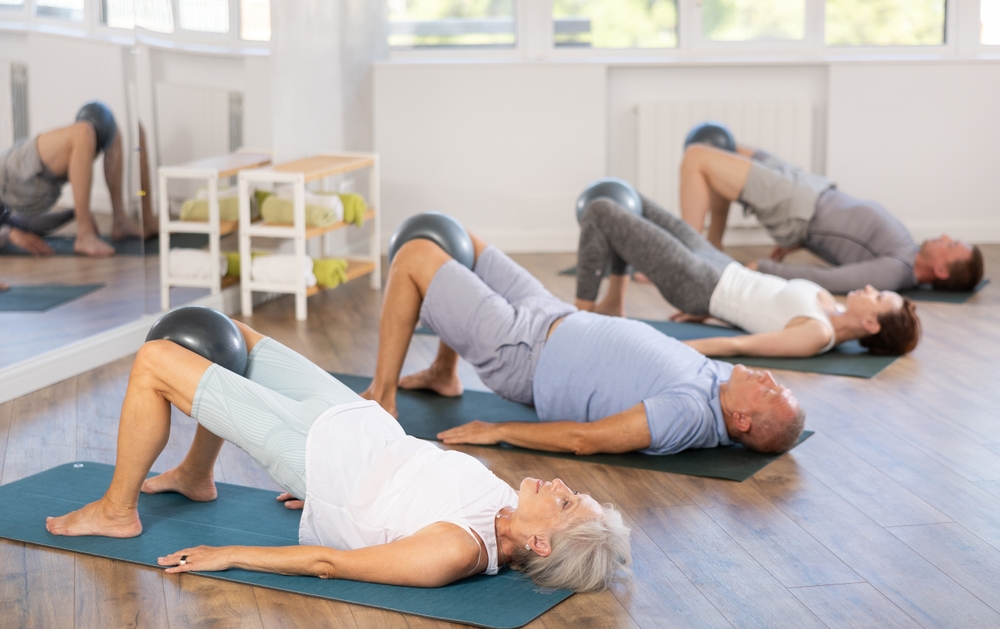
🔸 1. Glute Bridge
Goal: activation and strengthening of the gluteus maximus
👉 Lie on your back, knees bent, feet on the floor
👉 Push through your heels to lift the pelvis
👉 Hold 2 seconds, lower slowly
🔎 Excellent for activating the glutes before heavier lifts. (PMC)
🔸 2. Hip Thrust
Goal: maximal gluteus maximus strength
👉 Upper back on a bench, feet grounded
👉 Drive hips upward while squeezing the glutes
💡 EMG studies show very high glute activation. (PMC)
🔸 3. Deep Squat
Goal: global functional movement
👉 Feet shoulder-width apart
👉 Sit back and down, then drive up through the heels
✅ Works glutes, thighs, and stabilizers together.
🔸 4. Forward Lunge
Goal: unilateral coordination and stability
👉 Step forward, lower rear knee toward the floor
👉 Push up using the front glute
✅ Reduces side-to-side muscular imbalances.
🔸 5. Side-Lying Leg Lifts
Goal: strengthen the gluteus medius
👉 Lie on your side, lift the top leg upward
✅ Excellent for lateral pelvic stability. (PMC)
🔸 6. Lateral Band Walk (Monster Walk)
Goal: coordinated glute activation
👉 Elastic band around thighs or ankles
👉 Take small lateral steps while keeping tension
💡 Ideal as a warm-up or finisher.
📈 Progression: How to Improve
To progress:
- increase load (weights or bands),
- increase volume (sets or reps),
- add complexity (single-leg or unstable variations).
Technique always comes first to ensure safety and effectiveness.
🦵 The Role of the Core
Effective exercises for the glutes and pelvis rely on coordination with the core muscles. Programs combining abdominal and glute training improve lumbopelvic stability more than glute work alone. (PMC)
🧪 Scientific Evidence: What Research Shows
Studies consistently support these exercises:
- High glute activation during hip thrusts (PMC)
- Improved pain and function in chronic low-back pain with glute strengthening (MDPI)
- Reduced pelvic rotation linked to stronger gluteus maximus (jkema.org)
🧘♀️ Before You Start
✅ Warm up 5–10 minutes
✅ Progress gradually
✅ Control breathing
✅ Allow adequate recovery
📌 Conclusion
Exercises for the glutes and pelvis are a cornerstone of effective training, whether for athletic performance or functional health. More than aesthetic work, they promote:
✔ better pelvic stability,
✔ improved dynamic posture,
✔ reduced lower-back pain,
✔ more efficient daily movement.With a structured, evidence-based approach, exercises for the glutes and pelvis can transform strength, coordination, and overall well-being , through smart progression, not shortcuts.
📚Sources
- PubMed Central (PMC) – Gluteus Maximus Activation during Common Strength and Hypertrophy Exercises. https://pmc.ncbi.nlm.nih.gov/articles/PMC7039033/ (PMC)
- PubMed Central (PMC) – A SYSTEMATIC REVIEW AND META-ANALYSIS OF …. https://pmc.ncbi.nlm.nih.gov/articles/PMC7727410/ (PMC)
- PubMed Central (PMC) – Effectiveness of Abdominal and Gluteus Medius Training in …. https://pmc.ncbi.nlm.nih.gov/articles/PMC7914958/ (PMC)
- MDPI – Effects of Gluteal Muscle Strengthening Exercise-Based Core Stabilization Training. https://www.mdpi.com/1648-9144/60/6/849 (MDPI)
- Journal of Kinesiology & Exercise Management – Correlation between Gluteus Maximus Strength and Pelvic Rotation. https://www.jkema.org/archive/view_article?pid=jkema-8-2-104 (jkema.org)